
At a Glance
- Flat PU belts up to 1300 mm wide typically require 9 kW (12-16 kg/h) of dry steam.
- Flat PU belts up to 2750 mm wide typically require 18 kW (24-32 kg/h) of dry steam.
- Modular plastic belts generally require a minimum of 18 kW of steam power.
- 36 kW steam generators are rarely required for flat belt cleaning.
- Modular belts should normally be cleaned in sections rather than across their full width.
- Dry steam should generally be the starting point for conveyor belt cleaning.
Understanding Steam Generator Sizes
When comparing industrial steam generators, it is important to understand what the power rating actually means.
The electrical power of a steam generator is normally quoted in kilowatts (kW). In simple terms, this is the amount of electrical energy available to heat water and generate steam.
For portable three-phase steam generators, there are practical limits imposed by standard industrial electrical supplies:
|
Steam Generator |
Dry Steam Output |
Typical Application |
|---|---|---|
|
12-16 kg/h |
Most flat belts up to 1300 mm |
|
|
24-32 kg/h |
Wide flat belts and most modular belts |
|
|
48-73 kg/h |
Specialist high-output applications |
A 9 kW steam generator is approximately the maximum realistic steam output that can be obtained from a standard European 16A three-phase socket.
Similarly, 18 kW is approximately the maximum practical output from a standard 32A three-phase supply, while 36 kW approaches the practical limit of a standard 63A industrial socket.
Why Steam Output Matters More Than kW
While the electrical power rating is useful, the figure that ultimately determines cleaning performance is the steam output, usually quoted in kilograms per hour (kg/h).
This figure tells you how much steam the machine can actually produce.
For conveyor belt cleaning, tray cleaning and particularly modular belt cleaning, steam flow rate is often a better indicator of real-world performance than electrical power alone.
When comparing machines, always check the quoted steam output and compare it against similar-sized units.
As a general rule, the best-performing steam generators tend to produce steam outputs towards the upper end of the expected range for their power class.
Beware of Inflated Power Ratings
When comparing specifications, it is worth checking exactly what is included in the advertised power rating.
Some manufacturers quote the total electrical consumption of the machine, including accessory sockets used to power equipment such as:
- Vacuum cleaners
- Pumps
- Ancillary equipment
For example, a steam generator advertised as “10 kW” may actually contain a 9 kW boiler and a 1 kW vacuum socket.
The important figure is the heating power available for steam production, not the total power consumption of the machine.
This is another reason why steam output in kg/h is often a more useful comparison than the headline kW rating.
Dry Steam vs Wet Steam Output
When comparing steam flow rates, ensure that the figures relate to dry steam output.
Dry steam contains very little liquid water and is generally the preferred starting point for conveyor belt cleaning applications.
Be cautious of exceptionally high quoted steam flow rates, as these can sometimes be achieved by increasing the moisture content of the steam.
The term “wet steam” can be used in two different ways:
- Steam generated at a lower pressure, resulting in a higher moisture content.
- Dry steam with additional water deliberately injected into the steam flow.
Both approaches increase the total mass flow rate leaving the machine and can make steam output figures appear larger.
While wet steam can be useful in certain specialist cleaning applications, it should not be used when comparing the underlying steam generation capability of different machines.
For this reason, steam generator selection should always be based on dry steam output in kg/h, as this provides the most meaningful comparison between different systems.
Flat Conveyor Belts
Flat PU conveyor belts are by far the most forgiving conveyor type when it comes to steam cleaning.
For the majority of food manufacturing applications, a 9 kW steam generator producing approximately 12-16 kg/h of dry steam is sufficient for cleaning flat belts up to approximately 1300 mm wide.
Typical products include:
- Chocolate
- Biscuits
- Snack bars
- Bakery products
- Cakes
- Pastries
- Flour-based products
- Cereals
- Confectionery
In these applications, contamination is generally located on the surface of the belt rather than trapped within the belt structure. As a result, the steam does not need to penetrate deep into the conveyor and can instead focus on softening and lifting contamination from a relatively smooth surface.
For wider flat belts, typically up to approximately 2750 mm wide, an 18 kW steam generator producing 24-32 kg/h of dry steam is normally sufficient.
One of the most common mistakes we see is factories purchasing 36 kW steam generators for flat belt cleaning applications.
In reality, this is rarely necessary.
Cleaning performance is often limited by factors such as:
- Steam contact time
- Belt speed
- Vacuum extraction
- Cleaning head design
- Operator technique
rather than the amount of steam available.
A larger steam generator also introduces practical disadvantages.
A 9 kW machine can operate from a standard 16A three-phase supply, while an 18 kW machine typically requires a 32A supply. A 36 kW steam generator generally requires a 63A socket.
While many factories have 16A and 32A sockets distributed around production areas, 63A supplies are often far less common.
This can significantly reduce the flexibility of the equipment. A steam generator that is ideal for one conveyor may be difficult to deploy elsewhere in the factory due to power availability, cable management or simple manoeuvrability.
For this reason, when cleaning flat conveyor belts, it is usually better to select the smallest steam generator capable of achieving the required cleaning performance rather than simply choosing the largest machine available.
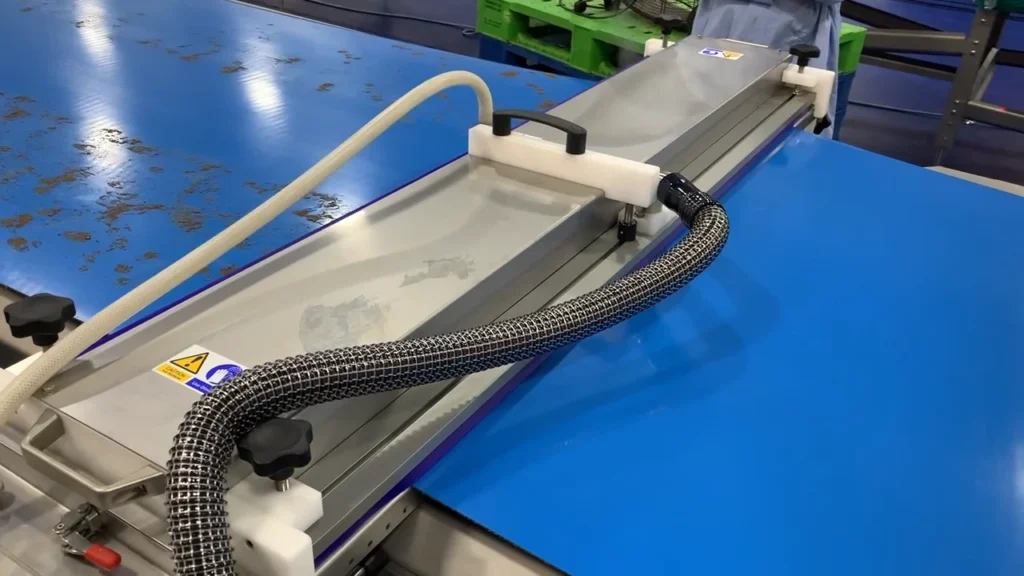
Brushless dry steam conveyor belt cleaning system removing chocolate residue from a flat PU conveyor belt during production cleaning.
As a general rule:
- Flat PU belts up to approximately 1300 mm wide: 9 kW
- Flat PU belts up to approximately 2750 mm wide: 18 kW
- Flat PU belts requiring 36 kW: uncommon
For most flat belt applications, increasing steam contact time will provide greater cleaning benefits than increasing steam power.
Modular Plastic Conveyor Belts
Modular plastic belts are an entirely different challenge.
While flat belts present a relatively smooth cleaning surface, modular belts contain numerous areas where contamination can accumulate, including:
- Hinges
- Links
- Underside structures
- Open mesh sections
- Dirt trap locations
The objective is no longer simply to clean the top surface of the belt. The steam must penetrate into the belt structure itself and deliver enough thermal energy to loosen and remove contamination from areas that are difficult to access.
For this reason, modular belts generally require significantly more steam power than flat belts.
As a starting point, we would normally recommend a minimum of 18 kW of steam power for modular belt cleaning applications.
However, there is another important difference.
Unlike a flat belt, it is generally not practical to clean the entire width of a modular belt at the same time.
There simply is not enough steam power available from a portable steam generator.
Instead, the available steam must be concentrated into a focused cleaning zone, typically using a rotating cleaning manifold between approximately 110 mm and 240 mm in diameter.
By concentrating the available steam into a smaller area, enough energy can be delivered to penetrate the belt structure and remove contamination from the dirt trap points that make modular belts difficult to clean.
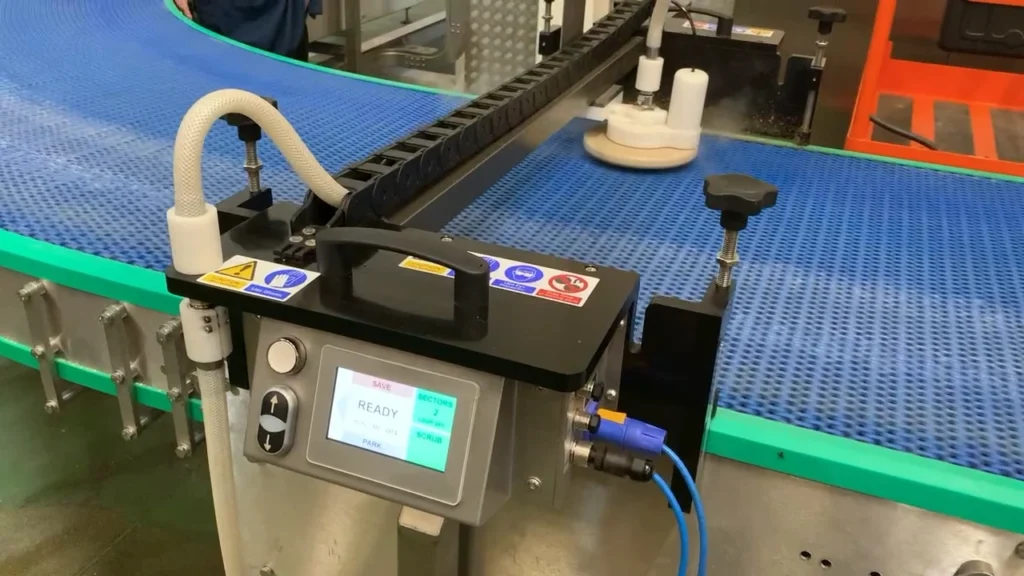
Modular plastic conveyor belts are typically cleaned in sections, concentrating steam power into a focused cleaning zone rather than cleaning the full belt width simultaneously.
Why Modular Belts Are Cleaned in Sections
Many people initially assume that cleaning the full width of the belt in a single pass must be the fastest solution.
In practice, it is usually neither practical nor economical.
Consider a relatively modest modular belt with a width of 600 mm.
If a common 180 mm cleaning manifold is used, the belt effectively needs to be divided into approximately three cleaning sectors.
Each sector may require around 18 kW of steam power to achieve effective cleaning.
To clean all three sectors simultaneously would therefore require approximately:
- 54 kW of steam power
- Multiple steam generators
- Significant electrical infrastructure
This is for a relatively narrow modular belt.
As belt widths increase, the steam requirement quickly becomes unrealistic.
A 1200 mm modular belt could theoretically require well over 100 kW of steam power to clean the full width simultaneously to the same cleaning standard.
At that point, portable steam generators are no longer a realistic solution and the discussion moves towards fixed factory steam systems and permanently installed cleaning equipment.
For this reason, the vast majority of successful modular belt cleaning systems divide the belt into sectors and clean one sector at a time.
Why Sectional Cleaning Is Usually Faster
Counterintuitively, cleaning a smaller section of the belt can often result in faster overall cleaning.
By concentrating the available steam power into a focused area, the cleaning system can:
- Increase steam penetration
- Increase heat transfer
- Improve contaminant removal
- Achieve deeper cleaning
Attempting to spread the same steam power across the full width of the belt often reduces cleaning effectiveness and can actually increase total cleaning time.
The most effective modular belt cleaning systems therefore focus on delivering the highest practical steam power density rather than attempting to clean the largest possible area.
Belt Speed Is Often More Important Than Steam Power
Another common misconception is that increasing steam power is always the best way to improve cleaning performance.
In reality, slowing the belt is often more effective.
A slower belt increases:
- Steam contact time
- Heat penetration
- Contaminant softening
- Overall cleaning effectiveness
As contact time increases, each cleaning sector can become wider while maintaining cleaning performance.
This means that a slower belt can often allow the entire conveyor to be cleaned faster while simultaneously delivering a deeper clean.
Although this may seem counterintuitive, it is a principle that is repeatedly observed in real-world modular belt cleaning applications.
For this reason, before increasing steam power, it is often worth evaluating whether belt speed can be reduced during the cleaning cycle.
In many cases, additional dwell time delivers a greater improvement than additional steam generation capacity.
Dry Steam vs Wet Steam
For most conveyor belt cleaning applications, dry steam should be the starting point.
Dry steam allows contamination to be softened and lifted without unnecessarily wetting the conveyor or surrounding production area.
This is particularly beneficial where:
- Fast drying is important
- Water usage must be minimised
- Product changeovers need to be completed quickly
- Cleaning is taking place in sensitive production environments
For many flat conveyor belt applications, dry steam alone is sufficient to achieve excellent cleaning results.
One of the major advantages of dry steam is its ability to transfer large amounts of energy into the contamination being cleaned.
When steam condenses on a surface, energy is transferred into the target material. Dry steam typically transfers more useful energy into the contamination than wet steam, making it particularly effective at:
- Denaturing proteins
- Softening fats and oils
- Breaking down biological residues
- Supporting microbial reduction
- Delivering energy deep into contamination
For this reason, dry steam is often preferred when the primary objective is hygiene and contaminant breakdown rather than simply debris removal.
However, there are situations where introducing additional moisture can be beneficial.
Wet steam typically provides greater mass flow and can create a more aggressive cleaning action at the belt surface. In practical terms, this can increase the ability of the steam to physically dislodge gross debris from the conveyor.
Additional moisture can sometimes help:
- Increase contaminant solubility
- Improve removal of loose debris
- Carry away contamination
- Increase the abrasive cleaning action at the belt surface
This can be particularly useful on heavily contaminated modular belts where the challenge is physically removing contamination trapped within the belt structure.
The important point is that more moisture does not automatically mean better cleaning.
Dry steam and wet steam are simply different tools for different objectives.
If the goal is maximum energy transfer, protein denaturation and hygiene performance, dry steam is usually the better choice.
If the goal is increasing the physical removal of stubborn debris, introducing additional moisture can sometimes improve results.
In our experience, the best approach is usually to establish an effective cleaning process using dry steam first and then introduce additional moisture only where there is a clear benefit.